
why i've fallen head over heels for Heated Rivalry
shane hollander as an autistic king & seeing queerness celebrated on screen

Warning: this article contains spoilers for Heated Rivalry season 1 and the book equivalent, and has some references to The Long Game book.
When I jumped on the Heated Rivalry bandwagon, I was pretty sure I was going to love it - so much so I waited until several big projects had wrapped, knowing how my brain can hyperfixate. What I didn’t expect was to see myself in a hockey player more than I maybe ever have in a character before.
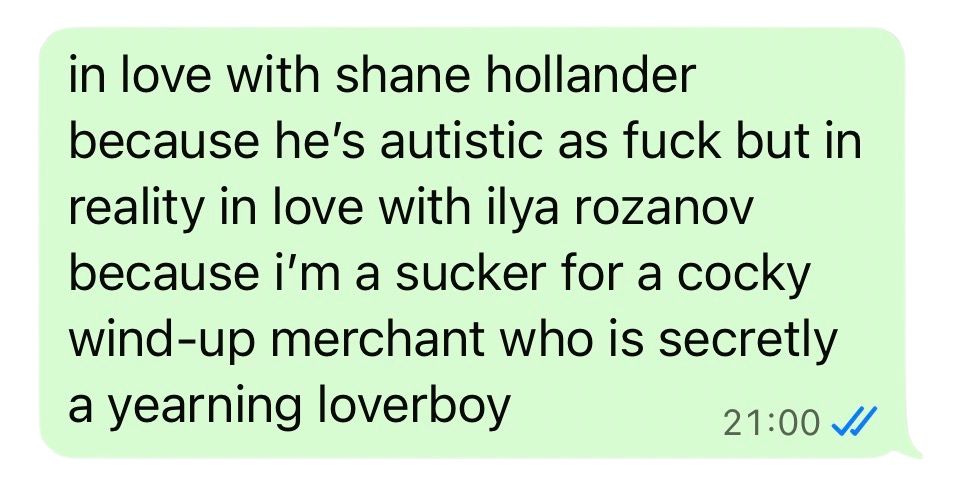
Heated Rivalry, if you’re not on that side of the internet (sorry to my therapist, who had to hear about it for about thirty minutes this week) follows two NHL ice hockey players who start off as rivals and end up in a ten year situationship resulting in them falling in love. Ilya Rosanov (Connor Storie) is a Russian player for Boston, and Shane Hollander (Hudson Williams) is a Canadian playing for Montreal. It is based on the book with the same name by Rachel Reid, part of the Game Changers series.
There has been a lot of criticism from various camps that the show is ‘just smut’, but I never hear that said about shows with straight couples that have this much backstory and complication. Heated Rivalry, from the first scenes, has storylines about abusive families, dementia, homophobia, and nods to other biases like those faced by Shane as a half-Asian player.
For me, Shane is a character I see myself in to a level I see quite rarely. Shane has been confirmed to be autistic by Rachel Reid, though undiagnosed and completely unaware of it - this makes sense, for someone in such a specific career and from a racial background that often sees people left undiagnosed. I often have debates - with myself, let alone anyone else - about whether it is truly representation if it is never acknowledged out loud, because representation is partially about people being able to understand, to name, the difference they are seeing.
This essay is not for that debate. Regardless of whether we see it as ‘autistic representation’, Shane is a character so evidently autistic done extremely well by Williams (who is nothing like Shane in real life), in a nuanced, subtle, gorgeous way.
Shane was a man of routine. He woke every morning at six o’clock and immediately went for a ten-kilometer run… Then he would shower. The rest of the day would be dictated by whatever was scheduled for him. He very rarely had a day with nothing planned.
From Heated Rivalry by Rachel Reid
Shane masks through almost everything. It’s seen socially, in interviews with journalists and in brand deals he is filming where he is awkward and struggles to act, and is awkward on stage and when presenting awards. But the mask is also shown in the way he is not known properly by almost anyone - his brand deals are for things he doesn’t love, set up by his mum as his manager; orange soda instead of the consistent ginger ale, for a different athleisure brand than he wears.
Introduced in the first seconds of the show as ‘not the most sociable’ but with the ‘highest IQ’, Shane avoids hanging out with his team apart from Hayden Pike, and spends a lot of his time notably alone - or with Ilya, of course. He does not get subtext and often has to ask for clarification on thoughts and feelings. Social norms, even in the hockey world, escape him (I greatly enjoyed him bringing wine to a hangout with his team, who are clearly beer or spirit drinkers, because his mum told him he should).
Ilya balances Shane in a way that is really rare and very beautiful. Ilya, with the rest of the world, is what can only be termed as arrogant, harsh, often angry. With Shane, we see him as soft, even if teasing, considerate, and extremely caring with issues like consent. Even though he calls Shane boring, you can tell he loves the other man’s consistency, and allows him to be exactly who he is. The language barrier means that Shane’s bluntness and flat affect actually lead to more effective communication for them both.
It doesn’t mean Ilya doesn’t use his lack of understanding jokes or sarcasm to his benefit to tease him - ‘how is the water?’ ‘you’re in it’ - or take any opportunity to laugh at his love for practicality (‘it’s good in the snow!’). But it’s not malicious - even when they supposedly hate each other. It’s rare to see someone so very embraced for who they are.
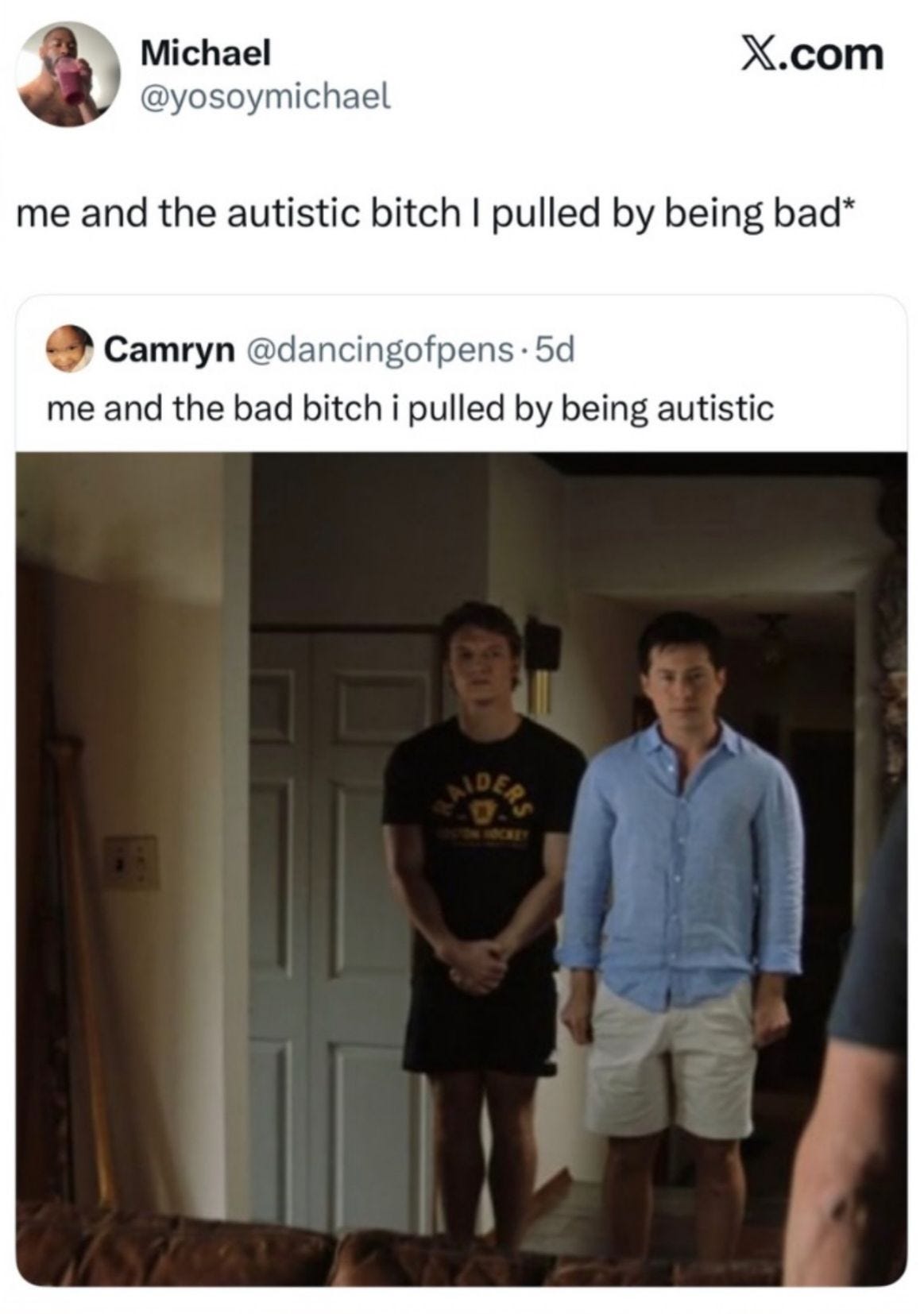
Shane’s autism is possibly seen most clearly in the final episode of the season, where him and Ilya are together at the cottage. This makes sense, because it is Shane’s safest place and the point at which he is most comfortable with Ilya, but also in the pacing and the storytelling of it being the slowest episode with the least time cuts. My favourite Shane moment might be him making eight burgers because the recipe is for eight, with Ilya asking why he didn’t cut it in half - literal thinking at its finest - and this is followed by the two engaging in parallel play on the sofa, both on their phones with their feet touching.
When they are discovered by Shane’s parents, we have the beautiful scenes with them, where they are completely okay with him and welcome Ilya into the fold immediately. But we also see Yuna, his mum, so upset at the notion he felt like he couldn’t be honest. In their conversation outside, she asks him to look at her - and he can’t. He scans her face, just slightly, then leans away again, visibly in discomfort as she pulls his face to hers. For me, this is extremely familiar; the way eye contact burns but I want people to believe I am listening to them, being asked by teachers or those around me to look at them in important moments but being so pained by it.
His panic, his anxiety, is shown throughout. Sometimes it’s more subtle, compared to the final episode where he panics and shuts down multiple times in the face of being outed and dealing with reality. This is dealt with incredibly well by Ilya, once again providing the exact needed balance. In The Long Game, their sequel story, we see how all of this comes to a head after Ilya has moved to Ottawa and they are both struggling with being apart and being secretive.
The Long Game has been criticised by some fans of the show and the first book, saying Shane is a terrible partner for not recognising Ilya’s pain and difficulty. But it is so very evident that he is just unaware, where his partner is not telling him about his needs, and is more often that not two hours away from him. There is no intent to be dismissive - they struggle to listen and talk to each other, and when they do finally break through it all, Shane is extremely receptive and open to making new and better plans. It is always difficult to see this sort of criticism of a character not only so nuanced - they both are - but written as different to their peers. It is indicative of a lack of progress: readers love him, until he is too autistic.
‘…a second later, the overhead lights dimmed by half. “Better?” Ilya asked. Shane glanced at the mirror. It was less intense, with the light dimmed…
“But you do [yoga and meditation]. So I have lights that dim. For you.”
Shane’s heart wobbled.
From The Long Game by Rachel Reid
Shane’s difficulty with emotional regulation is seen across both books and in the show through not only the coming out episode but across their long situationship. He is sometimes easily irritated and holds in many of his emotions, them overflowing slightly often or leaving him unable to put a finger on them. This is almost exactly how I feel the world, and it is visible in Shane even without words; the slight processing delays, the unsent texts, the way he snaps just slightly.
Some smaller aspects of Shane could be argued as due to cost - the show was made on a shoestring budget - like continually wearing the same clothes, often unironed. But for me, it all just adds to the picture of who he is and why he is, and this is why he is one of the best characters I’ve seen myself in, because it has been thought about properly. It’s subtle, but consistent. It’s there if you look for it, but it’s also there if you don’t.
“I like it,” he admitted. “Do these pants come in other colours?”
From The Long Game by Rachel Reid
I’ve seen some people criticise Williams for ‘bad acting’, in things like being slightly monotone compared to Storrie’s emotion next to him, and of course, Storrie has the added elements of Russian accent and language which is incredibly impressive. But when you see any interview with Williams, it becomes clear if you didn’t already know - it’s intentional, not poor acting, which should be seen as impressive in its own way. It’s a part of who Shane is, the flat affect and softer showing of facial expressions.
Away from Shane, I think the show is incredibly done in so many ways. I am particularly impressed by the pacing; the insertion of Scott and Kip’s story halfway through to slow us right down, followed by the opening montage in episode 4 which speeds us back up to Shane and Ilya’s story again and allows us to then see the impact of Scott’s coming out on the pair. It’s a really clever way of doing it and means the changing speeds aren’t jarring, and we don’t feel disconcerted moving from a story which takes place over only a few months to going back to the ten-year timeline for the main pair.
I love the soundtrack, full of indie tunes instead of big hits, and I hope that continues even with the show going global. I love the use of darkness and light as the show moves between different emotions. It’s incredibly impressive that there are so many tiny details of their relationship revealed through the use of things like montage.
Coming out for the first time in 2014 means I’ve seen how the winds have changed when it comes to queer TV and movies, and I think if you showed many of us Heated Rivalry and the way it has taken over the internet back then it would have been unfathomable. Yes, there is smut, and I’m sure that’s why some people have fallen in love with it. But that’s not it in its entirety, and there is so much joy, love, and complicated emotion across just six episodes.
I’m beyond excited to see how Jacob Tierney takes The Long Game and puts it on screen - I just hope that people are kind to these characters when the exploration of mental health, depression and disordered eating impacts their relationship. We have to allow for complex stories, real stories, and celebrate the resolution of those too.
Seeing this show - still showing the difficulties queer people face, but primarily focused on joy and love - is something so crucial amongst this political climate. Seeing it take the world by storm is something I never could have imagined even a few years ago. I desperately hope that we get more like Heated Rivalry, Red White and Royal Blue, and Heartstopper in coming years with a variety of queer representation that gets the same reception.

If you made it this far, thank you so much for reading! If you’d like to support me, you can become a free or paid subscriber, or buy me a coffee (a pink lemonade, actually)💫
yes to absolutely all of this! and I shared this on threads last week but as an autistic girlie who admittedly used alcohol as a tool to feel less uncomfortable while socializing for way too long, watching Shane switch from his go-to ginger ale to beer during his heavily masking/trying to be something he’s not phase just makes me want to wrap him in a big hug and tell him he doesn’t have to do anything (or anyone!) he doesn’t want to do. and also: I am a boring autistic queer and my partner is an attractive ADHD menace and I think we need to start talking more about how hot double-neurodivergent relationships can be now that we’ve seen Shane and Ilya represent us both!